PeopleOf CwmammanCwmamman's Fallen Heroes
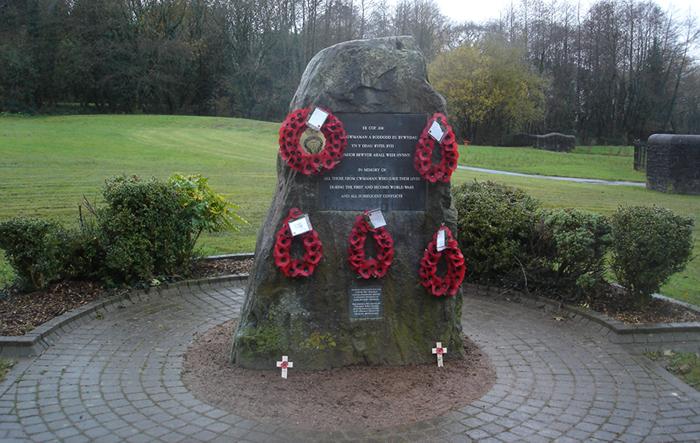
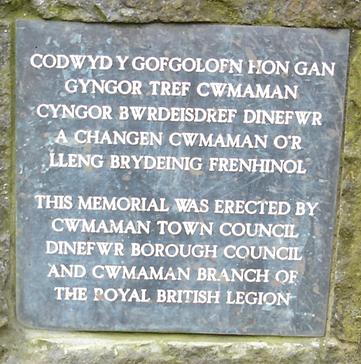
The Memorial Stone at Parc Golwg yr Aman at Garnant Cwmamman was once a thriving industrial village, with the heavy industries of the tinplate works and collieries providing the great majority of employment for the workmen of the Amman Valley. The tinplate works were dangerous places and the perils of working underground are widely acknowledged. The risk to life through accidents at collieries was sadly accepted by the workmen as part of everyday life. Put simply; when you went to work underground, there was no guarantee that you would be coming home again. The industry had it's share of heroes, such as Thomas Thomas who was decorated with the George Cross for his exceptional courage. There are many examples of miners putting their own lives at risk in an attempt to save their colleagues when things went wrong. What is not widely known in the locality today, is that the villages of Garnant and Glanamman lost 65 of its sons in military action: 45 during the First World War, known commonly as the Great War; 19 during the Second World War and 1 in 1955, who was shot by accident when returning from patrol in Malaya. Cwmamman was proud of its young men who were fighting in the Great War. This is illustrated by the fact that when they returned on leave, the Amman Valley Chronicle would print their names and wish them well. In addition to this, their respective chapels and churches would hold a reception concert for the men whilst they were on leave and they would be given a standard gift of £1, from the Cwmamman Soldiers and Sailors Fund. The reception would end with the singing of the National Anthem. Sometimes, other gifts would also be given and an example of this is the silver mounted sword given to Lieutenant Bertie Fisher by his fellow officials at the Gelliceidrim Colliery. He received this while home on leave in February 1916 after spending 16 months at the front. His function was held at the Plough and Harrow at Glanamman Square. In March of 1916, Brynseion Chapel held a "send
off" concert for Stoker W Davies, who was attached to H.M.S.
Pembroke, when he returned to Cwmamman on short leave. In May, the
chapel held another concert for Private Johnny Jones when he arrived
back in the village from his training quarters in Rhyl. Despite a government imposed restriction on the amount
of paper available to newspaper companies, they still used valuable
space to celebrate and report on the ordinary soldiers from the community.
For example, it was reported that Private Rees John Roberts was on
leave unable to go out to France with his battalion the previous month
due to the state of his health and was instead currently stationed
at Brecon, hoping to rejoin his battalion before long. Looking back through old copies of the local newspapers from that time, it is moving to read articles from 1916 which celebrate the return of men on leave from the front. It is easy to imagine the joy felt by those who knew them, when they saw them after they had been away fighting for their country. One can imagine the lift or even excitement shared by friends, neighbours and fellow members of their congregations when these men turned up in their uniforms. Some came directly from the trenches, while others returned having been recuperating from illnesses and injuries at convalescent homes. At Easter 1916, some of the men from Cwmamman came home on short leave. These were:
Private David Bendle had been wounded in France by shrapnel and Private Melvyn Llewelyn had suffered from dysentry while fighting in the Dardanelles. The Amman Valley Chronicle expressed concern that as a member of St Margaret's Church, Private David Bendle would get a reception concert but as Private Melvyn Llewelyn wasn't a member of any church or chapel, he probably wouldn't get a reception. Private Melvyn Llewelyn did, however, get a reception concert and both men received an undisclosed but substantial sum. This article was made all the more poignant by the fact that today we can see three of the above names on our village memorial. Private David Bendle was killed in action at Flanders
on the 23rd of July 1918; he was only 21 years old. His superior officers
paid a glowing tribute to his bravery and popularity. Alas, this wasn't the only household in Cwmamman to have lost two sons. David and Elizabeth Thomas who lived on the man road in Garnant also had two sons fighting in France, neither of whom returned. Private David Thomas studied for a B.A. at Cardiff University before emigrating to Canada, where he became a teacher at Vancouver. He died in October 1916, having fought several battles as one of the Canadian forces. His younger brother, William enlisted soon after the war started in 1914 and fought in several battles before he was killed on the 30th of September in 1917, having survived over three years of the war. How can one reconcile the pride of a parent who has seen their children take the bold step of emigrating to far off lands, such as Australia and Canada to make a better life for themselves; with the news that despite their endeavours, they had been lost on a battlefield in France or Belgium. How too can one imagine the grief that these parents had to endure when they learned that another son had also perished in the horrors of battle. The fact is that every soldier's parents were afraid, irrespective of how proud they were and these fears were often realised. A post card received by the parents of Private Rees Rees informed them that their son had been wounded in Mesopotamia. Further information on the nature of his injury came in the form of a letter from his pal, Private Gwilym Morgan, who gave them full details of how their son had been shot through the shoulder. Thankfully, we can see today that neither of these names are on our memorial. It is not surprising then that a man from Glanamman appealed for his 34 year old son to be exempt from conscription. The man stated that he had five sons, four of whom were already serving; 3 in France and one in South Africa. This was the only son that he had left in the country and his wife was absolutely dependant on him as her parents had died. His eldest son had already been in four wars and he asked for total exemption as he thought that his family had met their responsibilities. The response from the presiding officer was to draw attention to a family at Cardiff who had seven sons and three son-in-laws serving. It should also be remembered though, that the local men who fought in the war were proud to fight for their country. An opera singer with the Covent Garden Opera Company, William Michael from Garnant, took part in a performance of "The Hymn of Praise" at Cwmamman in March 1916. Instead of wearing his best suit as one would expect, he conducted his performance wearing Khaki, having joined the Overseas Battalion As mentioned earlier, every man, whether home from the
front or on his last leave before proceeding to the front, was presented
with a cheque for £1. By June the 15th 1916, 102 "Gallant
Lads" had received cheques from the Cwmamman Soldiers and Sailors
Fund. Such was the esteem held for the servicemen that £400
had already been subscribed, under £10 of which had been obtained
through entertainment. The rest had been collected by voluntary contributions
raised at the rate of 1 shilling per man and sixpence per boy earning
per month. Armistice day; the 11th of November 1918 meant the end of hostilities between the Allied Forces and Germany, but the Great War officially ended with the signing of the Treaty of Versailles on the 28th of June 1919. The Amman Valley Chronicle referred to the event as "the most historic occasion in the history of the whole world". After the Great War had ended and
the soldiers were "Demobilised", local celebrations included
a Memorial Service which was held on Sunday the 13th of July, 1919.
This was organised by Mr John A. Bracey, manager of the Amman Tinplate
Works at Garnant. He was also responsible for compiling a list of
names for the Cwmamman
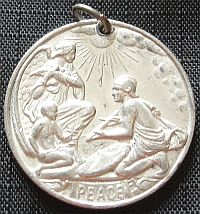
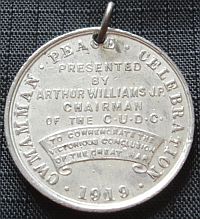
Roll of Honour. "Peace Day" was celebrated across Britain on Saturday the 19th of July 1919, with Cwmamman enjoying it's share of festivities. Flags and bunting abounded the streets and thanksgiving services were held at the local churches and chapels. At the local schools, 2,240 children were presented with Cwmamman Peace Commemoration Medals, given by Mr Arthur Williams of the Gelly. More medals were to be ordered and presented at a later date to meet the shortfall.
The Cwmamman peace medals were silver coloured and may have been made from Britannia metal. They were approximately 1¼ inches (33 mm) in diameter. At 1:30 pm, a procession of Police, the U.D. Council, Cwmamman Silver Band and the war veterans gathered at Glanamman Square and marched as far as the Raven Colliery before heading back towards the park. Over 2,000 children lined the steets waving small flags and these were later given a tea at their respective schools, which had also been decorated for the occasion. The cost of the childrens' tea was met by Mr and Mrs Folland of Glanamman. At the park, speeches were given by various councillors, and the festivities continued with various childrens races and a pillow fight. In the evening, there were fireworks and a dance which lasted until late. Over 5,000 people were present at the park to celebrate Peace Day. Christchurch at Garnant and Brynseion Chapel at Glanamman both contain names of those lost in action. Until recently, those remembered at the Remembrance Sunday services, were only a few of the actual number of men who lost their lives in the terrible Hell of battle during the two world wars. The Memorial Stone at Parc Golwg yr Amman currently has no names listed upon it.
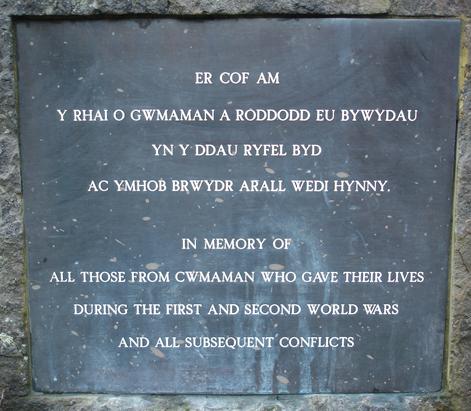
Top Plaque on Cwmamman Cenotaph
Bottom Plaque on Cwmamman Cenotaph Twenty years of research by Nevin Anthony of Garnant, himself a formerWelch Fusilier, has resulted in the compilation of a comprehensive list of names and details of the men, two of whom were postumously awarded the Military Medal. The first deceased solder to receive the Military Medal
was (12094) Sergeant John William Crump. He served at "Y"
Company; 4th Battalion of the Worcester Regiment during the first
world war. He was killed in action at Flanders on the 16th of August,
1917. He was only 23 years old. The second posthumously awarded Military Medal was awarded
to (1236378) Lance Corporal Hermas Llewelyn who served at 275 Field
Company of the Royal Engineers. He was killed in action at Egypt on
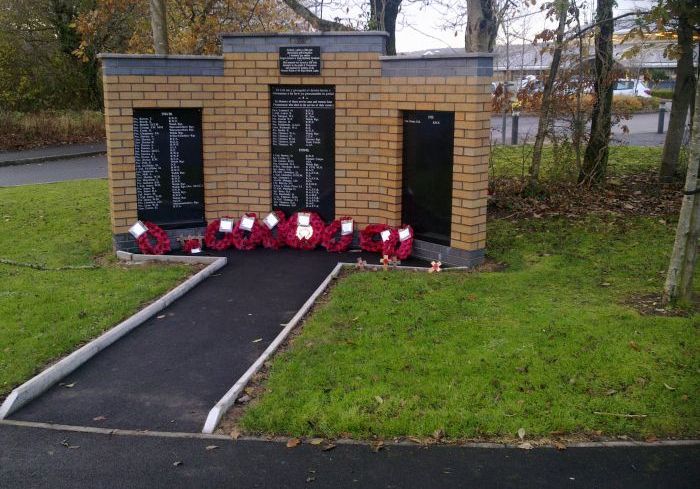
the 15th of February, 1943. He was aged 29 and involved in mine disposal. There were other heroes who did not die in battle, but earned medals for their courageous actions. One such local hero was Henry Parker of Ceidrim Villas, Glanamman. Whilst at Happencourt in France, on the 21st of October 1918, armed with a Lewis gun, he held back the enemy from a distance of 100 yards (metres), as they emerged from a sunken road. While holding off the enemy in order for his company to withdraw, Henry Parker was severely wounded. He was later awarded the Military Medal. Terrible events such as war inevitably create circumstances where ordinary people do extraordinary things, sometimes paying the highest price for the sake of their fellow men and women. It is fitting that these acts are recognised and recorded. It is also of utmost importance that those who did not get medals are also remembered within their community; especially those who never came home. At 11am on the 11th of November each year, the people of the British Isles; some gathered around Cenotaphs, others going about their daily lives, share two minutes of silence. The intention is that we ponder upon those sons, fathers, brothers, uncles, nephews and cousins who had their lives taken from them through violence caused by governments and despots, in order that we may go about our daily business and raise our children without fear of oppression. Names may be read out in services, but the personalities behind the names remain anonymous to those who never knew them; as does the now invisible grief of those families who lost those they loved in past conflicts. We should also remember todays servicemen and women and the dangers they face daily. The Garnant branch of the Royal British Legion was established in 1924 and the members held their 84th annual general meeting in 2008. The occasion saw the election of Nevin Anthony as President. All of the branch members were united in acknowledging the contribution made by former President, Colonel Tony Rogers. 2008 also marked the 90th anniversary of Armistice day, when the Great War came to an end. The Cwmamman Remembrance Service was held at the Memorial Stone at Garnant's Golwg yr Aman Park, on Sunday the 9th of November at 10:45am. Amongst those who gathered together in the wind and the rain were representatives of the Garnant Branch of the British Legion and children from the local Brownies. After the laying of the wreaths, there then followed a parade from the stone to Christchurch Garnant, where the service continued. The minister who conducted the service was the Rev. John Thomas, a former R.A.F. serviceman who served during the 2nd world war and who is also an ex Royal Chaplain. Garnant British Legion's fundraising endeavours resulted in a new war memorial being unveiled at Ysgol y Bedol on the 24th of April 2010. The names of Cwmamman's fallen heroes are now proudly displayed for all to see. Please click on the name plates in the photograph below for an enlarged image.
Memorial at Ysgol y Bedol, Garnant On the 4th of August, Garnant branch of the Royal British Legion joined the rest of Britain in holding a candlelit vigil to commemorate the 100th Anniversary of the start of the Great War. Candles burned on the path to and around the memorial at Ysgol y Bedol, these having been lit at 10pm and a service was conducted as part of the event. The names of the fallen were read aloud by the President, Nevin Anthony. Each of those present took it in turn to blow out a candle, the last one being extinguished at 11pm. A single flame was also placed at the old memorial at Parc Golwg yr Aman. The nationwide candle vigil was symbolic of the words spoken by Foreign Secretary Sir Edward Grey in August 1914, as it became clear that war with Germany was imminent. He said: "The lamps are going out all over Europe, we shall not see them lit again in our lifetime." His words seem to be in contrast to the general belief of the masses that it would "all be over by Christmas". History shows us that it would be over four years before it would end and cost millions of lives. It also changed the nature our country forever in so many ways, not least, changing the roles that women played in British society, many having had to adopt traditional male roles because of a shortage of a male labour force. Garnant branch of the Royal British Legion marked it's 90th anniversary with a service at Christchurch, which started at 2:30pm on Saturday the 11th of October, 2014. The event was organised by John and Pauline Barker and included performances by Cwmamman Male Voice Choir, the Childrens Choir from Ysgol y Bedol and Gwaun-cae-gurwen Silver Band. The congregation, which included two mayors and the Leader of Carmarthenshire County Council, Kevin Madge, accompanied the gentlemen of Cwmamman Choir in renditions of traditional songs from the Great War, such as "It's a long way to Tipperary", "Roses of Picardy", "Over There", "Keep the Home Fire's Burning" and "Pack up your troubles in your old kit bag". John Barker recited "In Flanders Field" by John McCrae and Pauline Barker gave a short address heralding the respect that the community held for the young men of Cwmamman, who were directly involved in the conflict of the Great War. The President of the Garnant Legion, Nevin Anthony solomnly read out the names of Cwmamman's Fallen and a two minutes silence was observed for reflection and as the customary mark of respect. Thanks to Nevin Anthony of Garnant for much of the information on this page. Please visit the Garnant Branch of the Royal British Legion website, (Webmaster: John Barker). |
|||||