|
|
Some Captured History of Glanamman and GarnantThe Thunderstorm of 1936 |
 |
|
In the afternoon, on Tuesday 30th June, 1936, the Amman Valley suffered a severe thunderstorm which caused damage throughout the locality. "Vivid flashes of lightening" and loud thunder was followed by torrential rain. The aftermath was reported in the July 2nd, 1936 edition of "The Amman Valley Chronice". This being in the days before homes were equiped with surge protectors, many mains connected wireless sets were damaged or destroyed and several windows in the district were smashed. One part of the railway near Amman United's playing field was under a foot of water and many houses in the vicinity suffered flooding. The flooded river carried away a sow from a farm in Garnant and the poor creature was drowned. The River Amman burst its banks in several places throughout the Amman Valley. In Ammanford, a house on New Road was struck by a bolt
of lightning, which reportedly entered through the chimney and made
a hole in the wall. Moses Thomas resided at the abode at the time and
his wife was in the room when the lightening struck. She was unharmed
apart from having a shock (not an electric shock!). At the Western Welsh
Omnibus Garage in Tirydail, Ammanford, one poor gentleman was not so
lucky. A 22 year old cleaner named Ken Johnston was rendered unconscious
for nearly five minutes when he sustained a "severe lightening
shock". How severe a shock he received may be open to interpretation,
as he was reportedly able to proceed with his duties after he recovered
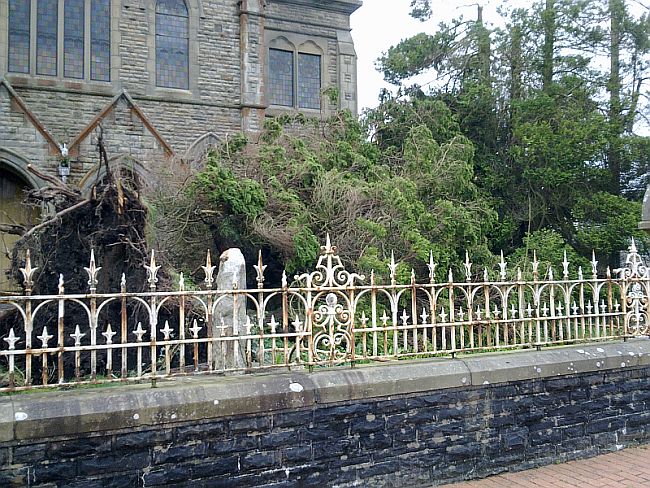
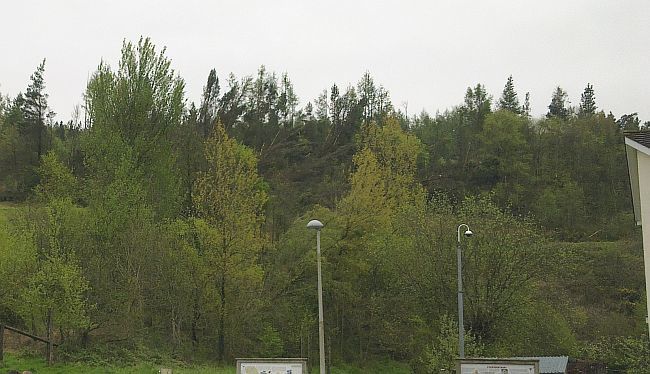
later on. Betws tennis courts were also completely submerged and at Newbridge, also in Betws, the chimney of the bakery was struck by lightning, causing damage to the masonry. That evening, after the storm had died down, a cleaner at Parcyrhun Council School discovered a fire at the premises when a bracket fell, revealing a burning beam. It was assumed that lightening had passed along a gas bracket and set alight to the roof beam to which it was attached. In contrast to the day's heavy rain, the drought which took place three years earlier in 1933, was severe enough to threaten the stoppage of work at the collieries of Cwmamman. There was a shortage of essential water needed for various methods of washing the coal and for the working of the screening plant. Although the thunderstorm of 1936 isn't regarded as one of the UK's worst recorded storms, it was certainly a dramatic event for the people of the Amman Valley. On Sunday the 29th of April 2012, the Amman Valley was subjected to a storm which consisted of winds of up to 60 miles per hour. Trees were uprooted on the hillside of Parc Gelliwerdd and one of the large fir trees in the grounds of Brynseion Chapel on Glanamman Square was toppled, thankfully missing the old building. The glass bus shelter at the Raven Park at Garnant was also blown over. In other areas of the locality, power lines were also brought down.
Fallen tree at Brynseion Chapel
Storm damage at Parc Gelliwerdd Possibly the worst storm to affect the UK occurred on the 7th to the 8th of December 1703, when the whole of the country was subjected to rain and high winds with gusts of up to 110 miles per hour in southern parts. Needless to say, flooding was widespread. The Wikipedia website informs us of a witness' account of the storm at Worcester where it was believed by some to be the manifestation of the wrath of God. Given the contemporary piety of Cwmamman's small population of farmers at that time, it would be reasonable to wonder what they made of it! Information for this article was taken from the Amman Valley Chronicle. |